Rising petrol prices trigger inflation worries, Dangote Refinery promises steady supply

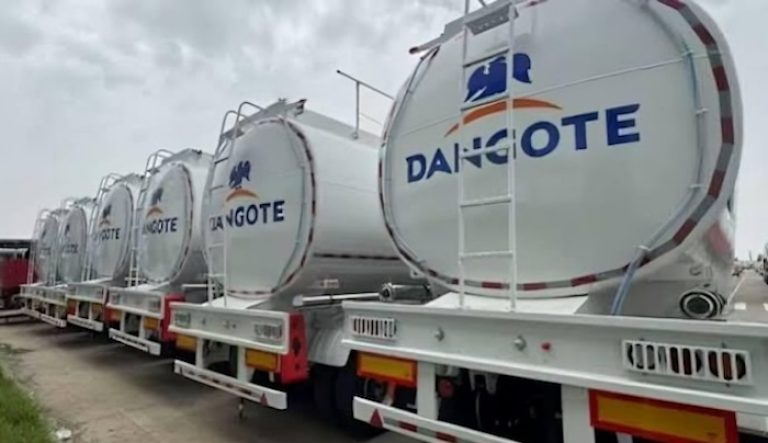

•Dangote fuel trucks
Fresh concerns over a global economic shock are mounting as oil prices surged sharply yesterday following escalating tensions in the Middle East and the emergence of Mojtaba Khamenei as Iran’s new supreme leader.
Following the global oil crisis, the Managing Director/Chief Executive Officer of Dangote Refinery and Petrochemicals, David Bird, assured that the refinery would continue to meet Nigeria’s fuel demand despite mounting volatility in global oil markets and rising costs across the international petroleum supply chain.
As expected, fresh pressure on household finances and transportation costs looms following Dangote’s new upward review of fuel prices, which has increased the gantry price of petrol to N1,175 per litre and diesel to N1,620 per litre, reports The Guardian.
Despite widespread expectation that the presence of domestic refineries should automatically translate into significantly cheaper petroleum products, the economics of refining suggest otherwise, according to the Centre for the Promotion of Private Enterprise (CPPE).
Meanwhile, the Petroleum Products Retail Outlets Owners Association of Nigeria (PETROAN) warned that petrol prices in Nigeria might rise to as high as N2,000 per litre and diesel prices could rise to about N3,000 per litre if the Middle East war persists.
Early Asian trading saw benchmark crude prices spike amid fears of supply disruptions from the region. Brent crude climbed to about $116 per barrel, while United States West Texas Intermediate (WTI) traded above $108, marking one of the sharpest single-day increases in recent years.
While the price is now almost double Nigeria’s 2026 budgetary benchmarks, it may push the pump price of petroleum products to a record high, a development that could affect the prices of other commodities, including food items.
The rally follows a dramatic escalation in hostilities involving Iran, Israel and the U.S., with reported strikes on energy facilities and military targets across the region.
With oil shipments already impacted, energy markets reacted swiftly as investors priced in the risk of reduced output and threats to tanker traffic across strategic shipping routes.
The leadership transition also comes after the death of Ayatollah Ali Khamenei, with the appointment of his son, Mojtaba, signalling continuity in Iran’s hardline political posture.
Beyond the oil market, global financial markets also slipped, with futures linked to the S&P 500 and the Nasdaq-100 falling amid heightened geopolitical uncertainty.
During a media chat, Bird said domestic refining capacity strengthened Nigeria’s energy security and positioned the country to avoid supply shortages that often affect nations dependent on imported petroleum products.
“Dangote Refinery will continue to meet Nigeria’s fuel demand despite global supply disruptions and market volatility,” he said.
According to him, the development of large-scale local refining has created a buffer for Nigeria against shocks in global fuel markets, where supply chain disruptions often lead to shortages and long fuel queues.
“Domestic refining gives Nigeria supply security, ensuring the country avoids fuel shortages and queues, even when global markets are disrupted,” he explained
Bird noted that the global oil market environment remained highly unstable, with crude oil prices experiencing sharp swings within a short period.
“Global oil markets are experiencing extreme volatility, with crude prices rising from the mid-$60 range to nearly $120 per barrel within a week,” he said.
Bird added that while the refinery operates in Nigeria, its operations remain closely tied to international commodity market conditions, particularly crude oil pricing and logistics costs.
According to him, the refinery does not receive discounted crude oil under Nigeria’s crude-for-naira arrangement, stressing that crude supply to the facility is still priced in line with global benchmarks.
Beyond crude pricing, Bird highlighted the sharp increase in shipping costs affecting the global oil trade, particularly tanker freight rates.
“Freight costs have surged dramatically, with tanker costs rising from about $800,000 to roughly $3.5 million per shipment in the present market environment,” he said.
He stressed that countries dependent on fuel imports were likely to bear the brunt of the ongoing market disruptions.
The latest adjustment marks the fourth price revision by the refinery since the beginning of March, raising concerns across the downstream petroleum market about the possible ripple effects on pump prices, transport fares and the broader cost of living.
Checks by our correspondent indicate that the revised rates have already been communicated to fuel marketers, who rely heavily on supplies from the refinery for distribution across various depots and retail outlets nationwide.
Under the new structure, the gantry price of Premium Motor Spirit (PMS), commonly known as petrol, increased from N995 per litre to N1,175 per litre, while Automotive Gas Oil (AGO), also known as diesel, rose from N1,430 per litre to N1,620 per litre.
The development reflects sustained pressure on domestic fuel supply pricing, driven largely by movements in international crude oil benchmarks and by supply dynamics within the local market.
For consumers and businesses, the sustained increases in fuel supply prices could further strain household budgets and operating expenses across key sectors of the economy
Our checks revealed that the price adjustment followed a temporary suspension of petrol loading operations and restricted truck-out activities at the refinery, developments that had earlier triggered speculation among marketers about a possible price review.
The refinery’s latest move coincides with a sharp surge in global crude oil prices recorded yesterday, a development that continues to exert pressure on fuel pricing in countries operating deregulated petroleum markets.
Data from international oil benchmarks yesterday showed that Brent crude climbed to $102.8 per barrel, up 10.91 per cent, while West Texas Intermediate (WTI) rose to $101.0 per barrel, up 11.08 per cent.
However, such fluctuations in the global crude market typically translate into higher landing costs for refined petroleum products and could influence pricing strategies by local refiners and fuel importers.
National President of PETROAN, Billy Gillis-Harry, stated yesterday that with no clear end to the conflict, petroleum product prices in both international and domestic markets were expected to rise sharply in the coming days.
Gillis-Harry, therefore, called on the Group Chief Executive Officer (GCEO) of Nigerian National Petroleum Company (NNPC) Limited, Bayo Ojulari, to facilitate the immediate commencement of production at Nigeria’s local refineries, particularly the Area 5 plant at Port Harcourt refinery and the Warri refinery.
He emphasised that revamping Nigeria’s refineries for immediate domestic production is critical.
Local refining, the PETROAN president said, would reduce exposure to international market volatility, especially given Nigeria’s abundant crude oil resources under the NNPC’s custody.
Chief Executive Officer (CEO) of CPPE, Dr Muda Yusuf, noted that recent adjustment in petroleum product prices in Nigeria reflects developments in the global energy market, particularly the sharp rise in crude oil prices triggered by escalating geopolitical tensions in the Middle East.
“Crude oil is the most critical input in the production of refined petroleum products and accounts for the largest share of refinery production costs worldwide. In recent weeks, global crude oil prices surged from about $65 per barrel to over $100 per barrel, an increase of over 50 per cent.
“This development has pushed up the cost of refined petroleum products across global markets, including PMS, diesel, aviation fuel and Liquefied Petroleum Gas (LPG). Because petroleum products are traded within an integrated global market, fluctuations in crude oil prices are inevitably transmitted to domestic fuel prices in most economies, including Nigeria,” he said.
Revealing that even crude supplied by local producers or the national oil company is priced using international crude oil benchmarks, he said domestic refineries also pay a premium of $3–$6/barrel to secure crude supply.
“Although domestic crude transactions may be settled in Naira under special arrangements, the underlying valuation is still largely based on the Naira equivalent of global crude prices. This means that domestic refining operations remain substantially exposed to global crude oil price movements with no price advantage in crude procurement. While local refining can improve supply stability, it cannot completely shield the domestic market from global oil price volatility,” he said.
Adding that the main cost advantage of domestic refining lies in reduced freight and logistics costs, he said importing petroleum products or crude oil involves significant expenses relating to shipping, marine insurance, port handling, demurrage and other logistics charges. “This advantage becomes particularly significant during periods of global supply disruption, when shipping costs and freight rates tend to rise sharply.
“Another strategic benefit of domestic refining is the strengthening of national energy security. For decades, Nigeria relied heavily on imported petroleum products despite being a major crude oil producer. This paradox exposed the country to significant supply chain risks and frequently resulted in fuel shortages and long queues at filling stations during periods of global supply disruptions.”