PWAN leads discussion on ending SGBV in Ebonyi as stakeholders recommend community enforced laws
By Oswald Agwu, Abakaliki

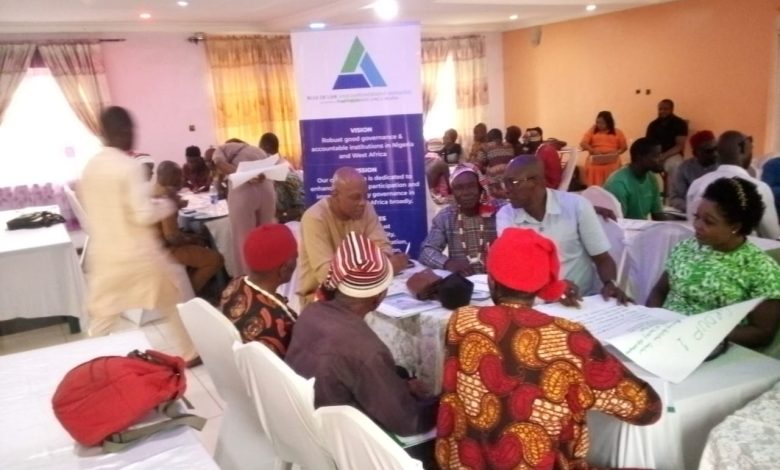

A non-governmental, non-profit organization, Rule of Law and Empowerment Initiative, also known as Partners West Africa Nigeria (PWAN), has led Ebonyi key stakeholders in a discussion towards ending sexual and gender based violence in the state.
The 2-day dialogue was part of activities in the implementation of PWAN’s project on proactive measures for preventing GBV in Ebonyi communities, supported by Ford Foundation.
It was held Thursday 20th and Friday 21st February in Abakaliki, Ebonyi state capital.
The stakeholders including traditional and religious leaders; the youth and women groups, relevant government MDAs, Security and justice actors were in consensus that SGBV practices are still prevalent in many communities in the state with far reaching negative effects ranging from psychological trauma to physical injury and death.
They identified its many forms and manifestations to include domestic violence, intimate partner abuse, rape, harmful widowhood and other traditional practices, female genital mutilation and deprivation of female children’s right to inheritance, among others.
Most discussants suggested, among other solutions, a collective community approach, involving community made and enforced laws against sexual and gender based violence as a surest approach towards eradicating the practice in Nigeria
They also hinted on the need for inter social group collaboration, making sure that the traditional and religious leaderships; youths, men and women groups as well as government and security agencies cooperate to eradicate the menace.
In a presentation, one of the facilitators, Oliver Chima Ajah, enjoined the traditional and religious leaders to employ their privileged positions in the grass roots to intensify actions against GBV.
Ajah, the Executive Director, Development and Integrity Intervention Goal Foundation, and the lead local partner with PWAN in the project, maintained that Laws passed by the community through the community leaders are more readily obeyed than all other alien laws, either from the state, federal or global arena.
Ajah said: “So, I am advocating for the communities, through their traditional rulers to make bye-laws against SGBV if we must succeed in the fight.
“Secondly, the religious leaders should use their pulpit to preach against it and also be role models.
“Communities should also make adjustments by moving some of their traditional initiation centres and squares away from people’s usual residential area so as not to interfer with women and other non initiates freedom of movement during their initiation and other ceremonies.”
In his submission, the traditional Ruler of Owutu Community in Edda, formerly Afikpo South LGA of the state, Ezeogo Ama Otu Uzor maintained that every culture was made by the people for the people, stressing that the traditional institutions have some powers to control certain actions in their domain.
“As traditional rulers, we have ways of handling matters.
“We can enact edicts or laws in our various communities to help reduce SGBV as long as it does not run contrary to the constitution of the federal republic of Nigeria and laws of the state” he emphasized.
In an interview, the programme Manager, Rule of Law and Empowerment Initiative, Aisha Isa Yusuf, explained that the dialogue session was part of the implementation of her Organisation’s 2- year project: Strengthening Police-community relationship in order to combat gender based violence in Nigeria, supported by Ford Foundation.
She noted that the project is piloted in 5 states in Nigeria including Ebonyi, where research showed a prevalence of SGBV, adding that it picked Afikpo and Edda as the pioneer local government areas in the state based also on the outcome of the research.
Yusuf explained: “We convened this dialogue in order to share experiences, challenges and identify gaps together with the stakeholders in the grassroots of Ebonyi state.
“So doing we will strategize through series of capacity building, sensitization workshops and other forms of advocacy towards ending GBV in the state.
“The core message of this meeting is the need to work together; for a collaboration among the traditional, religious leaders, the youth and women groups; relevant government MDAs, Security and justice actors in order to collectively combat GBV in our society.
“With the resources we will get from this meeting, we will go back to daft curriculum plans and strategies for capacity building and road map for referrals in order to tackle well the issue of SGBV.”
Others who interacted with newsmen including the CAN Patron Edda LGA, Rev. David Agwu and a woman leader from Ohaisu community in Afikpo local government area, Mrs Ngozi Okoro, harped on value reorientation and the need for victims to speak up as a means of tackling perpetrators.
“There is an urgent need to upgrade our value system, to put aside especially those traditional practices that would trigger gender based violence”, Agwu submitted.
While emphasizing that speaking out would enable victims get help in the face of GBV, Mrs Okoro however noted that some of the women’s experiences, especially as concerns freedom of movement in certain times were no longer regarded as GBV by women in her community.
She explained: “Some of the traditional restrictions, especially against women often considered as GBV are no longer viewed as such among the women in my community because we’ve grown with it from childhood and we are accustomed to them as part of our communal existence as non initiates into the traditional cult exclusively meant for the men.”
Meanwhile, all the stakeholders at the meeting made commitments to work together to ensure that the menace is reduced to the barest minimum if not totally eradicated in the state.
PWAN is a non-governmental, non profit organization, dedicated to enhancing citizens’ participation and promoting security and good governance in Nigeria and West Africa.