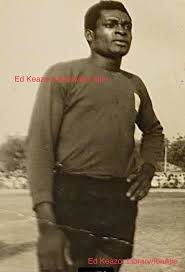

Legendary goalie Emmanuel Okala and younger brother Patrick remain the first Nigerian siblings to win African Nations Cup gold, silver and bronze. Unfortunately, death separated them in 1991.
The senior Okala thinks of his brother every day of his life but is grateful to God that the little children he left behind have grown up well and continue to remind family and friends of their father who they barely knew.
“I will never forget Patrick, his death was painful. I have his photograph handy so I see him everyday. He served Nigeria just like I did. I pray the country we served does not forget Chuka’s services. His two daughters are adults now and living fulfilled lives,” Okala told me.
Goalkeeping runs in the Okala family of Onitsha. Although Patrick joined his elder brother to guard the post for Enugu Rangers, there was someone before them. He lived in the Garden City.
“My uncle Walter, a product of Christ the King College (CKC) Onitsha, played for Port Harcourt Red Devils. I was also a Red Devil but my own team was in Onitsha. Another younger brother, Charles, also tried goalkeeping,” Okala explained.
Patrick was in goal for Nigeria when the Green Eagles lost in the grand finale of the African Nations Cup, Cote d’Ivoire 1984. Before that duel which ended 3-1, Peter Rufai manned the posts.
The younger Okala was Coach Adegboye Onigbinde’s first choice when the Eagles flew to China for the Great Wall Cup in 1984. In the game against Germany, he fell to injury and was replaced by Patrick Udoh.
That injury affected the Nigeria team which was depleted because some players were also not fit, coupled with the cold that demobilised their play. It was so bad that another keeper, Best Ogedegbe was used as a striker and Onigbinde almost drafted his assistant, James Peters, to play.
The squad was captained by Bala Ali. Christian Nwokocha joined from the United States. Kingsley Paul, Fatai Amoo, Clement Temile, Paul Okoku, Kayode Balogun, Yisa Sofoluwe and Sola Popo were also there.
Udoh, who shared room with Patrick Okala described his friend as a “complete gentleman who was not partisan when it came to politics and tribe. I attended his wedding in Enugu.”
Charles Okonkwo has fond memories of the late goalie. They shared room during the Flying Antelopes’ international engagements and when Okonkwo influenced another goalie, David Ngodigha, to join Rangers, Okala did not see it as a threat.
“Patrick was quiet, not given to temper tantrums and chose carefully the company he kept,” Okonkwo wrote. Both players were billed to unite in Europe after the latter traveled. Six months later, the keeper was no more.
Emmanuel Anthony Oguejiofor Okala has soldiered on since his brother departed. He regaled me with stories of his past. Voted African Footballer of the Year, 1978, by the African Sports Journalists Union (ASJU), he cherishes the trophy presented by Gen. Gnassingbe Eyadema of Togo.
“I have the trophy in my house and it means so much to me. I also want to use this opportunity to correct the impression that I joined Rangers in 1971. No, I moved to Rangers in 1970 from Onitsha Red Devils, same day as Godwin Adimnachukwu.”
Okala talked about his Flying Antelopes debut. “It was in the Amachree Cup, 1971, against WNDC(now Shooting Stars). My brother and friend, Cyril Okosieme, was first choice but in that game, the technical crew picked me.
“Chukwuma Igweonu, came to me, tapped my shoulder and asked me to be strong that the players were there for me. We defeated Shooting Stars but it was a terrible day for me. Niyi (Aderoju) Omowon broke nearly all my teeth. I still suffer the effects.”
Okosieme returned to the post after the match and Rangers won their first league trophy, qualifying to represent the country in the 1971 CAF Champions League. It was also in the same year that Shooting Stars defeated Rangers 2-1, to lift the Challenge Cup.
Okala also reminded me of his Eagles debut. “In 1972, we were preparing for the Second All Africa Games in Lagos. Taifa Stars of Tanzania came for friendlies. The first game in Benin ended 1-0 in our favour. I think Sylvester Egborge scored.
“Mid-Western State governor, Brig. Sam Ogbemudia, was not happy. He threatened to withdraw Vipers of Benin players if we did not up sit up. Some of us didn’t like that. We resolved to do better, in the next match at Onikan. We were leading 3-0, then Tanzania fought back and equalised. Eyo Essien was withdrawn and I came on.”
Okala was the first Nigerian to keep at the National Stadium, Surulere. The opening match against Mali saw Yakubu Mambo scoring the first goal on that ground. The first hat – trick came through Gideon Njoku
Ogbemudia was close to the Eagles. According to Okala, “he would drive his mini Jeep to our Afuze Training Camp, from Benin, as early as 5.00 am, to watch our road walk. Only his Aide De Camp (ADC) accompanied him.”
When Okala wants to be humorous, you will laugh and laugh. I taunted him that fellow players feared his aggression and looks, while in goal. In Ghana today, the story is that he slapped Kwasi Owusu in Lagos, in 1973.
His reaction: “No, no. When I go up to catch the ball, you don’t expect me to remain in the air. In the process of landing, maybe, someone would be affected. It was not deliberate.”
Petit Sory of Hafia and Guinea, was excited to meet me in 1990. The striker said they feared Okala but was happy he beat the goalie in Lagos.
Okala was indeed outstanding. On July 13, 1975, he bruised Brazzaville. Green Eagles were in Congo and Sunny Oyarekhua, scored in the very first minute. From that moment, the Red Devils (Baton Rouge) played all 89 minutes in the Nigerian half. They did not know that the magic man started as a Red Devil.
Congo were African champions in 1972 and still had a bunch of stars. Keeper Paul Tandoh, Minga Pepe, Moukila Paul, Francois M’pele, Jean – Michel M’bono, Jonas Bahamnoula, all big names. Okala could not be beaten. It ended 1-0. Unfortunately, Radio Nigeria had transmission problem. Bisi Lawrence got back to Lagos to learn that Okala’s exploits were not aired.
On September 4, 1977, Okala captained Nigeria to win the soccer gold of the First ECOWAS Games, in Lagos. Nigeria beat Ghana 2-1. Patrick Ekeji of Vasco Da Gama, scored one of the goals, playing as a left back instead of his traditional right.
A day earlier, Okala was in goal when AS Police of Senegal forced Rangers to a barren draw, at Sportscity, the same venue were Eagles picked gold. That was the first time a Nigerian player would would feature in two international competitive matches in 48 hours. Rangers advanced to win the African Winners Cup.
Emma Okala bagged African Nations Cup gold in 1980, bronze in 1978 and Patrick Chuka Okala got silver for the family in 1984. Emma and Austin Okocha equalled that in 2002. JayJay’s sister ‘influenced’ that when she married Chuka Iwobi, an Onitsha man, like the Okalas. Their son, Alex, has won bronze and silver with the Super Eagles.
*Emeka is an iconoclastic historian and sports enthusiast