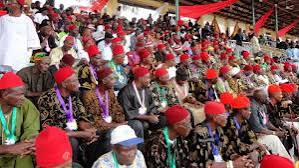

IN a powerful and reflective statement issued on Monday, Ndigbo Lagos, the umbrella body coordinating all Igbo organisations in Lagos State and surrounding areas, has called for unity, justice, and mutual respect amid simmering ethnic tensions in Nigeria’s commercial capital.
In a statement signed by Major General Obi Abel Umahi (rtd), and Chuma Igwe, the group reminded Lagosians and the wider public of the deep-rooted presence and longstanding contributions of the Igbo community in Lagos stretching back to pre-independence years, while denouncing attempts to stoke division through misinformation and revisionist history, reports Realnews.
The group’s statement comes in response to what it described as “divisive rhetoric” and symbolic acts that threaten communal harmony, including the renaming of streets bearing Igbo legacies and the resurgence of inflammatory narratives such as the so-called “Igbo takeover” of Lagos.
“We speak not in defiance, but in dignity,” the statement reads.
“We are guests but we are also stakeholders. Our contributions are woven into the city’s fabric, as builders, investors, educators and peacemakers.”
Ndigbo Lagos emphasized that the Igbo identity is grounded in migration with purpose, not displacement, and that wherever they reside, Lagos included, they seek to uplift, contribute and integrate.
The group also condemned what it called the “weaponisation” of the phrase “Lagos is a no man’s land,” clarifying that it did not originate as an insult to Yoruba heritage. Instead, they traced its origin to the 1940s, when Nigeria’s first Speaker of the House, Jaja Wachuku, used the term to reflect the capital’s federal character.
“This narrative has been hijacked and twisted to fan ethnic animosity. But the phrase, in its original context, was about inclusion not erasure,” the statement asserts, referencing how even respected Yoruba leaders like Lateef Jakande echoed similar sentiments about Lagos being a home for all Nigerians.
The group also appeals to multiple stakeholders, including the Igbo community, their Yoruba neighbours, the Lagos State Government, Southeast political leaders and the Igbo diaspora to avoid inflammatory rhetoric and pursue collaboration, understanding, and peace.
To Igbos in Lagos, the group urged restraint and grace in the face of provocation:
“Let your response to provocation be measured, not reactive… Our power lies not in noise, but in quiet excellence.”
To Yoruba neighbours, the message was equally conciliatory:
“We are neighbours, not rivals. Let us not allow the noise of politics to drown the quiet truth of our shared history.”
And to the Lagos State Government, the group urged mature and inclusive leadership:
“Inclusive governance is not a concession — it is a mark of courage… Revisiting policies or gestures that alienate any segment of its population will not be seen as weakness, but as wisdom.”
The statement concluded with a set of proposals to foster long-term harmony, including:
· Creation of an Inter-Ethnic Peace Council
· Cultural Exchange Programmes for youths
· Joint Cross-Tribal Development Projects
· Civic recognitions celebrating contributions of all ethnic groups
“Let temporary tensions not spoil eternal ties,” the leaders wrote. “Let no political misstep destroy decades of unity. Let Lagos rise not in division, but in dignity,” the group added.