Gender-based Violence: Stakeholders endorse integrated action as WACOL, Ford Foundation fortify capacity of MDAs in Ebonyi
By Oswald Agwu, Abakaliki

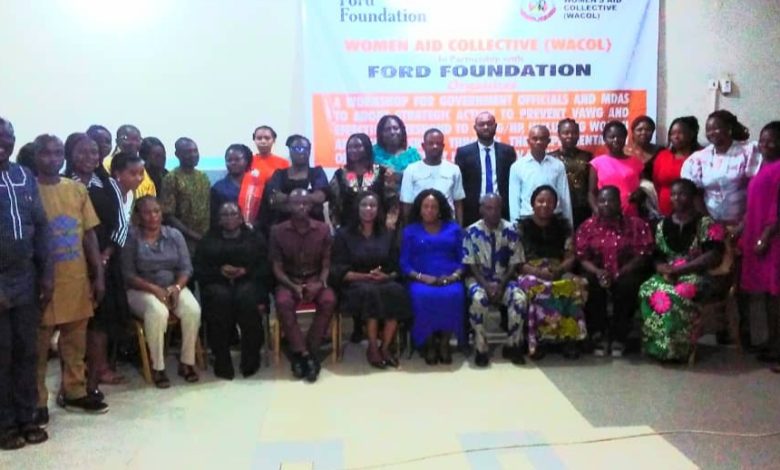

Adopting integrated approach and coordinated strategies by all stakeholders has been identified as key in ending Gender-based violence in Nigeria.
This was part of resolutions at a one day capacity strengthening workshop for government officials, Ministries, Departments and Agencies in Ebonyi State, organised by a Nongovernmental organization, Women Aid Collective, WACOL, in partnership with Ford Foundation, New York.
It was held on Monday, September 15, in Abakaliki, the Ebonyi state capital.
The training was focused on preventing and responding to violence and other harmful practices against women and girls, including women’s sexual and reproductive health and rights.
Participants drawn from the State Ministries of Justice, Women Affairs, education, Health, Youth Development, Information as well as the Police, Judiciary and the National Human Rights Commission, among others, were in consensus that integrated action would enhance understanding and promote coordinated strategies to contain the ever evolving dimensions of the menace.
Taking participants through the connotations of violence against women and the roles of prosecuting agencies, the WACOL’s Legal officer and key facilitator for the event, Helen Kalu, explained that VAWG thrive in patriarchy, myths and misconceptions which constantly make women and girls vulnerable.
Describing GBV as a global menace, she explained that 1 in every 3 women globally is affected by GBV while 35 percent worldwide have experienced either physical or sexual abuse with 200 million women having experienced Female genital mutilation.
She faulted the notion that indicent dressing is a major cause of rape and sexual violations in society describing it as one of the misconceptions which tends to excuse perpetrators.
She said: “Though we condemn indicent dressing in all its manifestations, what about under-aged children, old women and minors being raped on daily basis.
Are those ones also attributable to indicent dressing?”
Kalu enjoined all government officials, MDA representatives to build networks and utilise it to fight GBV in the State.
She added: “GBV is not a “women’s issue”. It is a human rights violation as well as an obstacle to the achievement of the objectives of equality, development and peace.
“It cannot therefore be addressed solely by law enforcement agents.
“It requires an integrated approach that enables all stakeholders to work in a coordinated manner to understand the problem, develop strategies to address the menace.”
Participants acknowledged that though the failure of institutions and systems: the judiciary, the police and the government bureaucracies in general have remained great impediments to winning the fight against VAWG, the family as the primary institution of socialization ought to stand firm in their duties to effectively stem violence against women and girls as well as all forms of gender-based violence.
Speaking, some of the participants including the State Coordinator, National Human Rights Commission, Christopher Okorie; the Head of Department, Women Affairs in the Ministry of Women Affairs and Social Development, Nwakaego Igboke; the Gender desk officer in the Ministry of Justice, Barr. Faithvin Nwanchor and the Programme Officer, Civil Resource Development and Documentation Centre, Goodness Mgbaja, called on Parents to always manifest good examples of love, self control and tolerance to their children.
“All these perpetrators of GBV: violence against women and girls, intimate partner abuses, domestic violence, rape and other harmful practices, they came from families.
“That being the case, it signifies the failure of parenting in the first instance.
“Granted that some government institutions most often compromise in the process of seeking redress for survivors, compromise from survivors and their families have been found to scuttle the course of justice the more” Mgbaja submitted.
All participants made commitment to effectively utilise their positions and offices to advance the fight through enhanced mutual connectivity and cooperation.
In an interview, the Executive Director, WACOL, Prof. Ngozi Ezeilo (SAN), represented by the Senior Programme Officer, Anulika Ezennia, said the training was aimed at enhancing mutual understanding and cooperation among the concerned agencies and build their knowledge on referral pathways to address gender-based violence.
She emphasized that failure of GBV victims to speak out have also impeded the fight against the practice, stressing that delays in justice system tends to also discourage victims from reporting.
Ezennia emphasized that WACOL and its partner organizations will not relent until the desired state of affairs is achieved in the fight against GBV.