FG’s move to reintegrate 744 ‘repentant’ terrorists sparks outrage, fear over fresh attacks

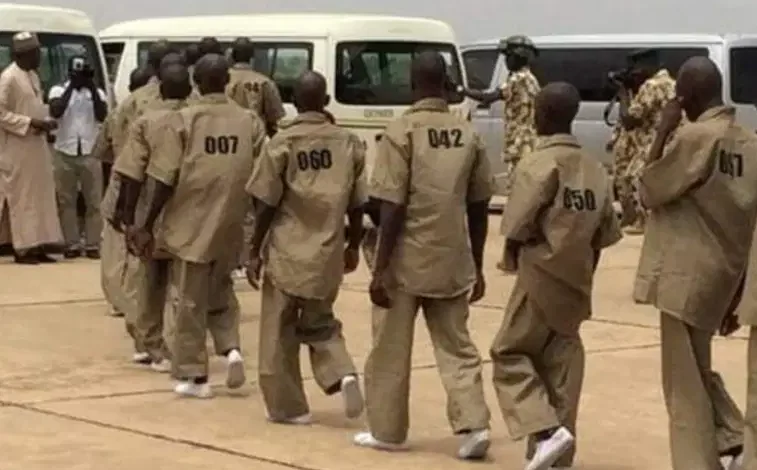

•’Repentant’ terrorists
A wave of anger has erupted across Nigeria following the Federal Government’s decision to reintegrate 744 former terrorists into society under its de-radicalisation programme.
The ex-fighters, drawn largely from the North-East, graduated from the Operation Safe Corridor camp after six months of rehabilitation, vocational training, and psychological reorientation, reports Saturday Vanguard.
While the military describes the initiative as a strategic effort to weaken insurgency, critics warn it could backfire — turning into a gateway for infiltration, impunity, and renewed violence.
‘Not De-radicalised, Just Disengaged’
Retired naval officer, Rear Admiral Dickson Olisemelogor, questioned the credibility of the programme, arguing that many of the so-called repentant fighters remain ideologically unchanged.
“What we are seeing is disengagement, not de-radicalisation,” he said.
“Some are sent back deliberately to gather intelligence or infiltrate security agencies. Many return to terrorism once the opportunity arises.”
He warned that without addressing root causes such as unemployment and ideological indoctrination, the programme risks recycling insurgents.
Security Fears From Within
A serving Major General, who spoke anonymously, described the policy as deeply flawed and dangerous.
“How do you reintegrate them into communities where their networks still exist?” he asked.
“They already have support systems. Some have even infiltrated institutions.”
He warned that sympathy for extremist groups within certain circles could further complicate Nigeria’s counterterrorism efforts.
‘A Mockery of Justice’
Legal practitioner, Dr Maxwell Opara, took an even stronger stance, vowing to head to court to stop the programme.
“This is an epitome of fraud,” he said.
“You cannot bypass investigation and prosecution and then release people who destroyed entire communities after just six months.”
He argued that the policy undermines the justice system and sends a dangerous message — that terrorism carries little consequence.
Victims Forgotten
For many Nigerians, the biggest concern is the perceived neglect of victims.
A Kano-based businesswoman, Aminat Saudi, who lost six relatives to terrorism, questioned the moral logic behind the programme.
“What happens to the victims?” she asked.
“Who compensates those whose families were killed, homes destroyed, and lives ruined?”
Human rights advocate Okechukwu Nwagunma echoed the concern, warning that reintegration without accountability risks eroding public trust.
“Reintegration must not translate into impunity,” he said.
“Without justice, transparency, and community involvement, it will fail.”
Fear, Anger, Distrust
Across the country, citizens and groups say the move could worsen insecurity.
The Northern States Christian Elders Forum warned it could create a “dangerous precedent,” encouraging others to take up arms with the hope of future rehabilitation.
Youth groups also cautioned that prioritising ex-fighters over victims could deepen resentment and fuel instability.
“It undermines trust,” the Northern Youth Council said.
“Peace cannot come at the expense of justice.”
A Divided Debate
Despite the backlash, some voices argue the programme could help weaken insurgent groups by encouraging defections.
Supporters say offering a path out of violence may reduce the number of active fighters over time.
But critics insist that without strict monitoring, transparency, and accountability, the policy risks doing more harm than good.
For many Nigerians, one question remains unanswered:
Can a country heal while those accused of destroying lives walk free?