Court slams Police for unlawfully declaring Sowore wanted, awards him ₦30m •Says ‘You can’t criminalise free speech

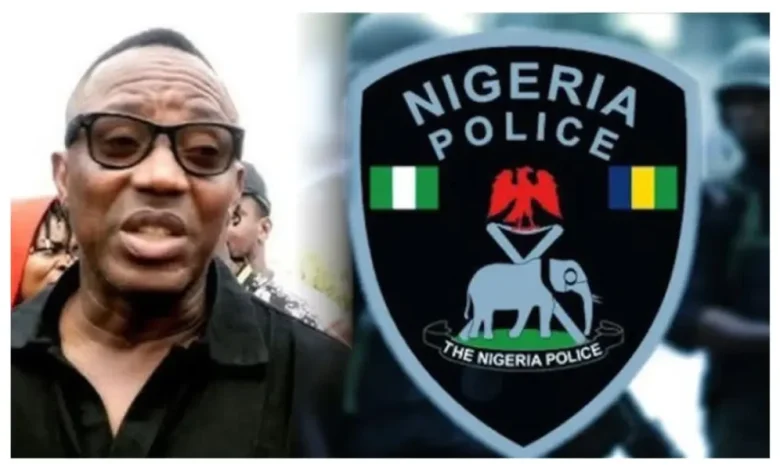

The Federal High Court in Lagos has ruled that the Nigeria Police acted unlawfully when they declared human rights activist and publisher of Sahara Reporters, Omoyele Sowore, wanted in 2025.
In its decision delivered on Friday, the court held that the action of the police violated the law. Justice Musa Kakaaki ordered the Nigeria Police Force, the Inspector-General of Police, Kayode Egbetokun, and the Lagos State Commissioner of Police, Moshood Jimoh, to pay ₦30 million as damages for the unlawful declaration.
Details of the judgment, shared by Sowore’s lawyer, showed that the court stressed that no Nigerian should be treated as a criminal for speaking out, protesting, or demanding accountability from the government.
The controversy began on November 3, 2025, when Jimoh publicly declared Sowore wanted. The police accused him of attempting to lead a protest on the Third Mainland Bridge against the demolition of poor communities in Oworonshoki, Lagos. Before that, in October 2025, the commissioner had directed Sowore to stay away from Lagos.
Unhappy with the development, Sowore filed a lawsuit against the commissioner, the Inspector-General of Police, and the Nigeria Police Force. He asked the court to protect his fundamental rights to dignity, personal liberty, freedom of movement, expression, and peaceful assembly as guaranteed under the Constitution and the African Charter on Human and Peoples’ Rights.
In a sworn statement, Sowore said he was declared wanted without being invited by the police, without a warrant, and without any formal charge. Through his legal team led by Tope Temokun, he argued that the declaration harmed his image and violated his constitutional rights. He also stated that he would have responded to any lawful invitation from the police.
Sowore asked the court to stop the police from harassing, intimidating, or arresting him. He also sought the cancellation of the wanted notice and demanded ₦500 million as general and exemplary damages.
The police, however, opposed the case. They maintained that Jimoh had the power to declare Sowore wanted.
While speaking on Channels Television’s Sunrise Daily on November 5, 2025, Jimoh insisted that the declaration was still valid and claimed that Sowore failed to appear at the State Criminal Investigation Department in Yaba as arranged by his lawyer.
“My declaration that Sowore is wanted is still in force,” he said at the time.
Jimoh also rejected claims that the Inspector-General of Police had ordered Sowore to be “shot on sight,” calling the allegation false.
In his ruling, Justice Kakaaki criticised what he described as lawless conduct by the police commissioner and held the Inspector-General responsible for the action.
The judge explained that before any citizen can be declared wanted, there must be approval from a court of law. He said such a step must come after a warrant has been issued, proper notice has been given, and there is evidence that the person is avoiding lawful procedures. Only then can a court authorise such a declaration.
The court described Jimoh’s October 27, 2025 directive asking Sowore to stay away from Lagos as arbitrary, unconstitutional, and outside the powers of the police.
It further ruled that the public announcement made on November 3, 2025, declaring Sowore wanted, was illegal, beyond the authority of the police, unconstitutional, and a serious abuse of power.
Reacting to the judgment, Sowore’s lawyer, Mr Temokun, described the decision as “a loud constitutional warning against the abuse of state power in Nigeria.”
“The misconduct of the Commissioner of Police, Lagos State, attracted judicial condemnation, and the Inspector-General of Police, Kayode Egbetokun, was held liable for that improper exercise of authority,” he wrote on Facebook.
He added, “We salute the courage of the Court for standing firmly on the side of justice, liberty, and constitutional governance.”