


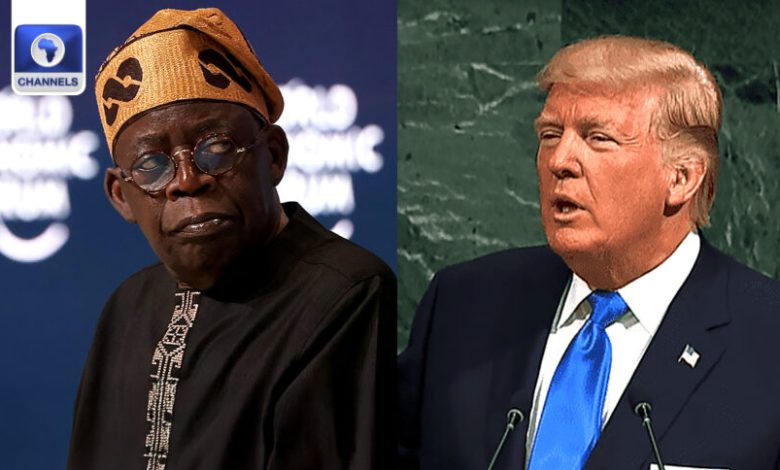

•US Presidents Trump and Tinubu
Just over a week after the United States launched strikes targeting militants in Nigeria on Christmas Day, a roadside bomb ripped through an armoured troop carrier, killing at least eight Nigerian soldiers.
Then, days ahead of a high-profile US-Nigeria security meeting in Abuja last week, armed gangs kidnapped more than 170 churchgoers in Nigeria’s northern Kaduna State, reports AFP.
Elsewhere, a suicide bomber hit a military convoy, killing half a dozen troops.
Violence has continued unabated despite US President Donald Trump’s stated goal of stemming the alleged mass killing of Christians in Africa’s most populous nation.
Security analysts say this is unsurprising.
“It would take a lot more than… a couple of bombardments to address Nigeria’s security challenges,” said Kabir Adamu of Beacon Security and Intelligence, calling for “a holistic approach” addressing “mass poverty”, “weak state governance structures” and jihadist financing networks.
– Game changer? –
The United States hit Nigeria’s northwest Sokoto State on Christmas Day in jointly coordinated strikes against Islamic State militants, the first direct action by Washington in the country.
Going forward, the United States will provide intelligence from aerial reconnaissance flights to aid Nigerian air strikes.
How much of a game-changer that will be remains to be seen.
US support since Nigeria’s 2009 jihadist uprising has not stopped the bloodshed.
A $346 million weapons sale last year was met with concern from advocates worried about the Nigerian military’s grim rights record — which had at times held up previous US arms sales.
US military efforts in the wider Sahel have failed to halt jihadist insurgency across Burkina Faso, Niger and Mali, although the security situation has deteriorated since US and French troops left the region.
Nigerian National Security Adviser (NSA), Nuhu Ribadu, said increased collaboration with the US had “resulted in the neutralisation of several hundreds of terrorists.”
It was unable to confirm those numbers, as Nigeria’s front lines are spread across vast swathes of unsecured rural terrain. Lately, the military has been claiming that dozens of jihadists were killed in anti-terror operations.
Neither the US nor Nigeria has released details of how many militants were killed in the Christmas Day strikes.
“Regardless of how many ISIS members were killed, it allowed the Nigerian security forces the opportunity to hit more transitory targets”, as the insurgents fled, Lieutenant General John Brennan, deputy commander of the United States Africa Command, told our correspondent.
Future cooperation would involve “the whole gamut of intel sharing, sharing… tactics, techniques, and procedures, as well as enabling (Nigeria) to procure more equipment,” he said.
– Christians at risk? –
Both militaries seem keen on the increased collaboration, even if diplomats are clashing over Trump’s rhetoric alleging the violence amounts to the “genocide” or persecution of Christians.
Independent analysts reject that, saying the overlapping security crises claim the lives of both Muslims and Christians, often without distinction.
None of Nigeria’s armed groups have publicly said they are targeting Christians in response to Trump’s comments, as some analysts worried might happen.
But a series of mass kidnappings and a slew of attacks on Christians in the northeast by the Islamic State West Africa Province have some researchers on edge.
“There were already many violent attacks against Christians before the strikes,” said James Barnett, a PhD candidate at the University of Oxford specialising in Nigerian conflict.
“But it has also been a very violent period since… So we can say at minimum that the US air strikes didn’t fundamentally help.”
Dozens of schools remain closed across the north of the country following a mass kidnapping of pupils at St Mary’s, a Catholic school in Niger State.
More than 250 students and staff were abducted in November, at the height of the diplomatic dispute between Abuja and Washington over Trump’s rhetoric.
Nigeria and the United States have largely reconciled. The students have been released.
But they remain out of the classroom — it’s been too dangerous for St. Mary’s to reopen.
Adejobi, a parent, said: “I later found out that the teachers joined the JUAC staff over their unmet demands by the FCT administration. I quickly took my daughters back home. I pray the strike do not last too long.”
At the Government Science Technical College in Abaji, only a few students were seen on the premises.
A few teachers were met under a tree, explaining that they were instructed to stay away from the classrooms in support of the JUAC action.
Similarly, at Unguwar Dodo LEA Primary School, academic activities were grounded.
A few pupils remained on the premises playing, but no teachers were present.
At Government Day Secondary School (GDSS) Gwagwalada, some students were in their classrooms, but no lessons were being taught. Students confirmed that their teachers did not turn up due to the strike.
At Bwari Area Council, several students were seen return home as early as 9 am yesterday.
Some of them told our correspondent that their teachers turned them back.
Reacting to the development, the president of the Parents Teachers Association (PTA) in the FCT, Alhaji Usman Abubakar, expressed concern over the schools’ shutdown.
“My worry is that the strike should not linger. We do not want a repeat of what happened during the teachers’ strike last year. I advise the FCT administration to seek dialogue and an out-of-court settlement with JUAC in the interest of industrial harmony,” he stated.
Activities across the six area councils of the FCT were also paralysed following a directive by the Nigeria Union of Local Government Employees (NULGE) to the workers to join the strike.
Our reporters, who visited the area councils, saw visitors, including contractors, discuss the strike in groups.
Striking workers block Wike’s office
There was a mild drama yesterday at the FCT Minister’s Office at Area 11, Garki District of Abuja, as striking workers blocked the entry gate upon learning that the Minister, Nyesom Wike, was inside.
They had earlier gathered at the National Industrial Court for a case brought against the JUAC’s president and the secretary by the FCT minister.
The suit seeks, among other things, to compel the striking workers to return to work.
The ruling on the case was, however, adjourned to January 27.
Shortly after the adjournment, the workers rushed to the minister’s office and blocked the entrance.
It was learnt that the minister hurriedly departed through the exit gate at the Ministry of Agriculture section of the secretariat.
Why workers resorted to strike
FCT JUAC President Rifkatu Iortyer, while declaring the strike, said the action followed what the union described as the administration’s “breach of trust,” “inaction,” and the “deliberate demoralization” of its workforce through a litany of unresolved grievances.
In an address titled “A Plethora of Festering Issues,” Comrade Iortyer presented an 11-point indictment of the FCTA management, accusing it of financial malfeasance, systemic failure, and acts of bad faith against employees. The union highlighted the non-remittance of pension and National Housing Fund (NHF) deductions as a “serious breach of trust and a threat to the future security of its members.”
The union also demanded the immediate removal of retired directors and permanent secretaries, calling their tenure extensions a “clear contravention” of the Public Service Rules. “We are appalled by the illegal extension of tenure of retired officers,” Iortyer stated.
Furthermore, the union rejected the recently approved promotions for about 2,000 FCT staff out of the more than 7,000 who sat for the 2024 promotion exercise. “We say no to the deliberate mass failure of the 2024 promotion exams, intended to avoid paying promotion arrears,” Iortyer said, describing the process as a system “designed to fail and demoralize our members.”
Other grievances include unpaid promotion arrears, poor working conditions, staff intimidation, lack of training, and the non-payment of Abuja Environmental Protection Board (AEPB) enforcement officers.
“We demand immediate action on these issues. We will not be silenced by inaction,” she warned.
10 out of 14 workers’ demands met – FCTA
Reacting to the ongoing strike earlier, the FCTA had said 10 out of the 14 demands made by the striking workers have been met, adding that the remaining issues are being addressed.
While the FCTA maintains that progress had been made, the union had dismissed these claims, asserting that none of their demands have been fulfilled.
The FCTA further noted that several unions, including the Law Officers Association of Nigeria, have dissociated themselves from the strike. The administration emphasized that these workers have the right to access their offices and perform their duties without interference.
Lere Olayinka, Senior Special Assistant on Public Communications and Social Media to the FCT Minister, noted that the Association of Resident Doctors (ARD-FCTA) recently wrote to Wike and appreciated his “exemplary leadership and commitment to healthcare workers’ welfare,” citing the payment of 13 months of hazard allowance arrears and a one-month wage award.
Olayinka stated that top FCTA officials had held several meetings with union leaders.
He said during a meeting with the Joint Union Action Committee (JUAC) on Friday, January 16, the Minister’s interventions were laid bare.
Olayinka stressed that the minister never expressed unwillingness to address any of the demands.
Previous strikes under Wike
Last year, primary school teachers and the area council workers embarked on a three-month industrial action over the non-payment of arrears.
Although the workers are under the jurisdiction of the area councils, the strike forced pupils out of schools for more than an academic term.
Stakeholders have berated Wike for his inability to resolve the dispute between the teachers and the area councils, which led to the significant loss of an academic term for pupils in public schools.
Almost concurrently, health workers in the area councils also embarked on a strike lasting over three months, crippling access to healthcare in rural communities.
While resident doctors called off their strike only recently, other health workers remain on strike, jeopardizing the health and well-being of Abuja residents.
Also, a civil society group, the Peoples Alliance for Indigenous Rights (PAIR), in a statement yesterday by its coordinator, Adolor Asoro, urged President Bola Tinubu to sack Wike, alleging that governance was failing in the nation’s capital.


