Israel–Somaliland pact signals major shift in Horn of Africa power dynamics

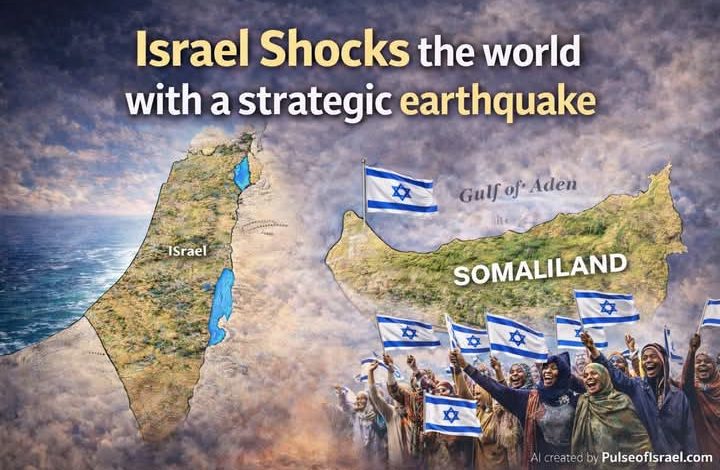

Israel has formally recognised Somaliland as an independent state, marking a historic diplomatic breakthrough that is already reshaping geopolitical calculations across the Horn of Africa and the wider Red Sea region.
The announcement, confirmed in a joint statement by both governments, establishes full diplomatic relations and paves the way for the exchange of ambassadors — making Israel the first UN member state to formally recognise Somaliland since it declared independence from Somalia in 1991.
“This decision reflects reality on the ground,” a senior Israeli official said. “Somaliland has demonstrated stability, responsible governance, and a commitment to regional security. Recognition is long overdue.”
In Hargeisa, scenes of celebration erupted as news spread. Citizens were seen waving Israeli flags and chanting in support of the decision, describing it as “a moment of long-delayed justice” for a people who have governed themselves for more than three decades.
“This is not just recognition — it is validation,” a Somaliland government spokesperson said. “We have built peace, held elections, and maintained security in one of the most volatile regions in the world. Today, that effort has been acknowledged.”
Strategic Implications
Situated at the mouth of the Bab el-Mandeb Strait — a critical maritime corridor linking the Red Sea to the Indian Ocean — Somaliland occupies one of the world’s most strategically significant locations. Analysts say Israel’s move strengthens its strategic depth in a region increasingly contested by rival powers.
“This is about more than diplomacy,” said a regional security analyst. “It’s about maritime security, intelligence cooperation, and protecting global trade routes that pass through one of the world’s most vulnerable chokepoints.”
Israeli officials have privately described the partnership as a “natural alignment” between two entities facing persistent security threats and committed to sovereignty, stability, and self-defence.
Regional Repercussions
The recognition has drawn criticism from Somalia and several regional actors, including Turkey and Qatar, which have invested heavily in Somalia’s political and security architecture. However, Somaliland officials dismissed the backlash.
“We are not seeking permission to exist,” a senior Somaliland official said. “Our legitimacy comes from our people, our institutions, and our record of peace.”
Analysts note that the move also complicates the ambitions of regional powers seeking ideological or military influence across the Horn of Africa.
“This decision challenges long-standing assumptions,” one regional observer said. “It signals that stability and governance — not ideology — are becoming the new currency of legitimacy.”
A Broader Strategic Shift
For Israel, the recognition extends the logic of the Abraham Accords beyond the Middle East, linking it with pragmatic partners focused on security, trade, and realism rather than ideological alignment.
“This is not symbolism,” an Israeli diplomatic source said. “It’s about anchoring alliances in places that matter — geographically and strategically.”
As global power dynamics continue to shift, the Israel–Somaliland agreement marks a clear statement: legitimacy follows stability, and influence follows action.