


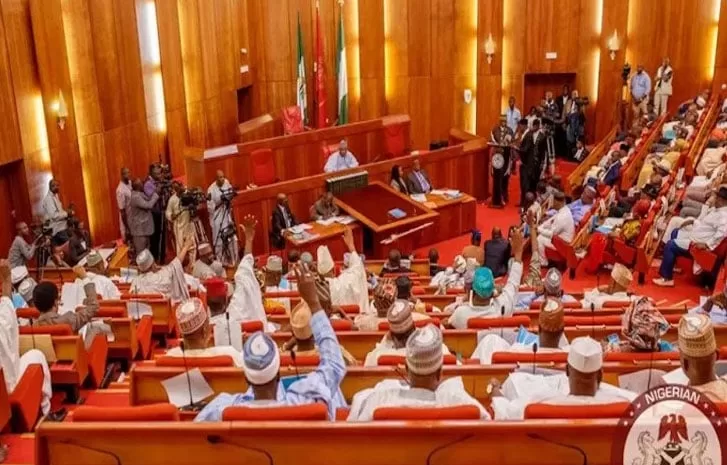

The Senate Wednesday passed for second reading ‘A Bill for an Act to Repeal and Re-Enact the 2024/2025 Appropriations Act,” which when enacted, would bring down the spending plan to a total sum of N43.56 trillion.
The proposed expenditure framework, according to the Senate, comprises N1.74 trillion for statutory transfers; N8.27 trillion for debt service; N11.27 trillion for recurrent (non-debt) expenditure and N22.28 trillion for capital expenditure and development fund contribution, as provided in the bill.
Consequently, the upper chamber disclosed that it had directed the Minister of Finance and Coordinating Minister of the Economy, Mr. Olawale Edun; Minister of Budget and National Planning, Senator Atiku Bagudu and Chairman, Federal Inland Revenue Service, Dr. Zacch Adedeji, among others, to appear before the Senate Committee on Appropriations today to provide further clarification on the proposed expenditure plan, reports Daily Independent.
Leading the debate on the amendment yesterday, Leader of the Senate, Senator Opeyemi Bamidele, explained the essence of this proposal, which according to him, was not merely procedural; it is structural and reform-driven.
He further argued that the bill sought “to repeal and re-enact the existing appropriation framework in order to bring an end to the unhealthy practice of running multiple budget cycles concurrently.”
He pointed out diverse explanations, which established that such a practice had historically undermined budget clarity, weakened fiscal discipline, and blurred accountability across ministries, departments and agencies.
He also noted that the amendment bill sought to provide a clear, grounded, and orderly appropriation mechanism that enables the government to lawfully consolidate, regularise, and appropriate expenditures that are critical, time-sensitive, and unavoidable, particularly those undertaken in response to emergency exigencies.”
Describing the proposal as a careful balance between responsiveness and responsibility, Bamidele explained that the amendment was designed to ensure that urgent public spending did not erode legislative oversight or fiscal prudence.
Rather, he added that the bill reinforced the collective well-being of Nigerians by ensuring that expenditures aimed at safeguarding national security, social stability, and economic continuity are not left in legal or administrative uncertainty.
At the same time, according to the Senate Leader, it strengthens the pillars of fiscal discipline, accountability, and prudent public financial management, which he said this Senate has consistently upheld.
He, thus, highlighted the benefit of the bill, which, according to him, would introduce and strengthen several critical safeguards, a requirement that appropriated funds are released and applied strictly for the purposes specified in the schedules approved by the National Assembly.
Bamidele, also, observed that the bill further showed that a clear provision that virement may only be effected with the prior approval of the National Assembly, thereby preventing unilateral budgetary reallocations.
He added that the provisions “collectively reaffirm the power of the purse vested in the legislature and ensure that executive flexibility does not translate into fiscal opacity or abuse.
“They deepen trust in public finance administration and reassure Nigerians that every naira appropriated is traceable, justified, and lawfully spent.
“The repeal and re-enactment of the Appropriation Act, as proposed, therefore represents a necessary legislative intervention to consolidate past actions, clarify ambiguities, and provide a stronger statutory foundation for present and future budget implementation,” the Leader of the Senate explained.
After Bamidele’s lead debate, the Senate, presided over by Deputy President of the Senate, Senator Barau I. Jibrin, passed the appropriation bill to second reading.
Jibrin, consequent upon the approval, referred the bill to the Senate Committee on Appropriations under the chairmanship of Senator Solomon Adeola while mandating it to report back to the plenary within two days.
Similarly, the House of Representatives yesterday received a letter from President Bola Ahmed Tinubu transmitting the Appropriation (Repeal and Re-enactment) Bill, 2024, seeking legislative approval for a consolidated 2025 budget aimed at ending the practice of running multiple budgets concurrently.
The letter, read on the floor by the Deputy Speaker, Hon. Benjamin Kalu, during plenary, explained that the bill was submitted in line with constitutional and legislative appropriation procedures and is intended to strengthen fiscal discipline, transparency, and accountability in public finance management.
According to the president, the bill seeks authorisation to issue a total sum of N43.56 trillion from the Consolidated Revenue Fund of the federation for the year ending December 31, 2025. The proposed expenditure breakdown includes N1.74 trillion for statutory transfers, N8.27 trillion for debt service, N11.27 trillion for recurrent non-debt expenditure, and N22.28 trillion for capital expenditure and development fund contributions.
The president noted that the bill is designed to consolidate critical and time-sensitive expenditures already undertaken in response to emergencies affecting national security and the collective well-being of Nigerians, while reinforcing prudent public financial management.
He added that the proposed legislation strengthens implementation discipline by mandating that appropriated funds be released and applied strictly for specified purposes, requiring National Assembly approval before any virement, providing for corrigenda where genuine errors may hinder implementation, and limiting the expenditure of excess revenue to legislative approval. The bill also mandates due process compliance and periodic reporting on fund releases and agency revenues.


