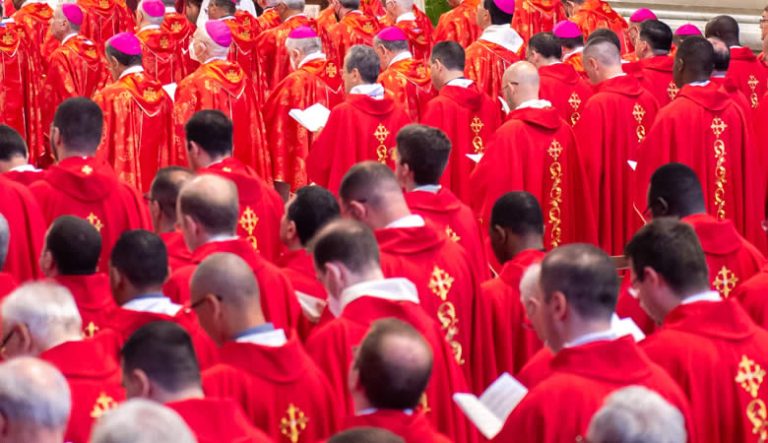

The 135 Cardinals of the Catholic Church below the statutory 80 years of age (Cardinal Electors) will today enter into the Sistine Chapel, located in the Apostolic Palace, or Papal Palace, at the Vatican to elect the 267th pope and successor to Pope Francis who died on Easter Monday – April 21, and was buried five days later.
A Papal Conclave in the Roman Catholic is a solemn, closed-door gathering of the College of Cardinals to elect a new pope, reports Daily Independent.
The term ‘conclave’ comes from the Latin term ‘con clavis’, meaning ‘with a key’, which makes reference to the tradition of locking the cardinals away until a new pope is elected, thus underlining the secrecy of the exercise.
The process of electing a Successor of Peter, it was gathered, begins with the 135 cardinal-electors taking an oath to keep all that transpires until the new pope is elected under wrap.
It is also the same thing with everyone in the Vatican during the conclave, from the two doctors (whose presence is for any emergency), to the chefs who will be feeding the cardinals, as everyone is under obligation to maintain secrecy for life.
Technically, there are electronic jammers to intercept any phone and WiFi signals from inside to the outside. On entering the conclave, everyone, including the cardinals are obligated to surrender their electronic devices like phones, smart watches and all other items that could communicate proceedings to the outside world, and there are purely Vatican police to enforce the rules.
Apart from age that may play a major role in the choice of a successor, between those in support of continuity and reforms, issues of how the church has handled sexual morality could also play a role. For example, leading candidates like Cardinal Pietro Parolin and Cardinal Luis Antonio Tagle had reportedly faced accusations of mishandling abuse claims during their tenures. These allegations are under scrutiny and may influence electors’ decisions.
There is also the challenge of ideological divides, with emphasis on global south versus global north. This is because cardinals from the Global South have emphasised issues like religious freedom, poverty and the impact of globalisation. Consequently, they may be favouring a pope who prioritises these concerns. Conversely, electors from the Global North are focused on the church’s stance on sexual abuse, ecumenism, and social inclusivity. These differing priorities reflect the ideological divide within the College of Cardinals.
Being a global figure, there is also the issue of diplomatic engagement in electing a new pope. This is premised on the Vatican’s approach and disposition towards international relations.
For example, Cardinal Parolin’s role in the 2018 Vatican-China agreement, which allowed Beijing a say in bishop appointments, has been criticised by some as compromising religious freedom and this may affect his candidacy and the church’s future diplomatic strategies.
A conclave can last up to several days and even in some cases, weeks before a new Pope is elected. The longest conclave in history lasted two years and nine months (from November 1268 to September 1, 1271). That longest conclave produced Pope Gregory X, who would go on to implement reforms aimed at preventing such prolonged conclaves in the future.
However, the shortest conclave in history was the 1503 election of Pope Julius II, which lasted only about 10 hours, a swift decision likely due to the strong influence and popularity of Giuliano della Rovere, who became Pope Julius II.
Some other notable short conclaves include those that produced Pope Pius XII on the third ballot in 1939 and in less than 24 hours; Pope John Paul I (1978), 33 hours; Pope Francis (2013), 27 hours, elected on the fifth ballot, and Pope Benedict XVI (2005), 24 hours, elected on the fourth ballot. Will this also be a swift decision?
That may or may not be the case today as the cardinals enter the Sistine Chapel. However, while the election of popes has been a long-standing tradition in the Catholic Church, several factors would likely play out in the choice of a replacement for Pope Francis.
While the cardinals may be torn between factors expected to influence their votes, there seems a consensus among the electors on the need to go for a younger occupant of the chair of Peter who would have years to address the contemporary challenges of the church in a more dynamic way. It was gathered, for example, that the cardinals are torn between continuity and reforms in the face of the challenges facing the church.
Those leading the charge for a younger pope may be looking at a generational shift in the leadership of the Roman Catholic Church. Incidentally, the 2025 conclave marks a significant generational turnover, with 14 cardinals retiring. This shift could influence the conclave’s dynamics, as newer electors may bring different perspectives and priorities to the selection process.
As of April 22, 2025, the average age of the 135 cardinal-electors eligible to vote in the conclave is approximately 69.8 years, reflecting a slight decrease from previous years, partly due to the appointment of younger cardinals by Pope Francis. Of all the electors, the youngest is Cardinal Mykola Bytchok of Ukraine, aged 45.
This is however in sharp contrast with the overall College of Cardinals, with an average age of 78. Nearly 41% of total number of Cardinals of the Church, including Cardinal Arinze, Anthony Cardinal Okogie retired Archbishop of the Lagos Archdiocese and Cardinal Onayekan of the Abuja Archdiocese, who are over 80.
This generational shift among electors may influence the conclave’s dynamics, potentially leading to a preference for a younger pope who can address contemporary challenges facing the Church.
Cardinal Bychok is the Bishop of the Ukrainian Catholic Eparchy of Saints Peter and Paul of Melbourne, which encompasses Ukrainian Catholics in Australia, New Zealand, and Oceania. The first cardinal from Australia since George Pell, he was appointed by Pope Francis on December 7, 2024, during a consistory at St. Peter’s Basilica in Rome.
Other younger cardinals are: Giorgio Marengo, 50 years; Américo Manuel Alves Aguiar, 51 years; George Jacob Koovakad, 51, who is Prefect of Dicastery for Interreligious Dialogue; Rolandas Makrickas, 53; and Frank Leo, 53, Metropolitan Archbishop of Toronto, as well as Nigeria’s Peter Cardinal Okpaleke, 62- currently serving as the Bishop of Ekwulobia who was elevated by Pope Francis on August 27, 2022.