


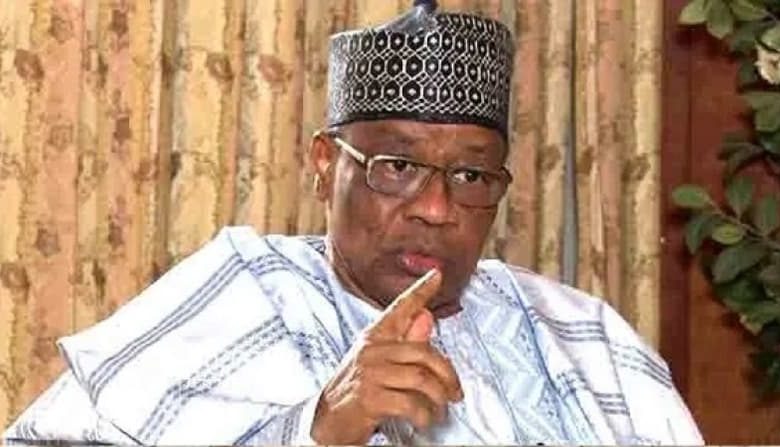

Ex-military ruler, General Ibrahim Babangida, has denied being afraid of late military ruler, Gen. Sani Abacha, who served as his Chief of Army Staff.
Babangida blames Abacha largely for the annulment of the results of the June 12, 1993 presidential election which he (Babangida) now admits was won by the late Chief Moshood Abiola, reports News Express.
Besides, he claims that Abacha also plotted to violently overthrow his administration.
Babangida, who had installed the late Chief Ernest Shenekan as head of an Interim National Government on August 27, 1993 to run the nation’s affairs, denies speculations that there was a pact in place for the late Abacha to succeed him in office.
“If, as I said earlier, Abacha was a clog in the wheel of the transition to civil rule process and had plotted to remove me as President violently, why didn’t we retire him to forestall the problems that later emerged?” he writes in his newly released memoirs, ‘A journey in Service.”
“Was there a pact between Abacha and me that he would succeed me? Was I afraid of him, fearful for my life? Why didn’t we ‘neutralise’ the other known opposition forces to the transition process?
“Why didn’t we take prompt action against the ABN for interfering with the transition process, in violation of Decree 19, which made it a criminal offence to hinder the transition?
“The answers to some of these questions are implicit in earlier sections of this chapter. No, there was no pact between Abacha and me.
“Yes, there were moments when my safety and the safety of all those dear to me were of concern. But the situation was so unstable that any wrong move on my part could have resulted in bloodletting.
“As I stated above, the military was so factionalised that any move against General Abacha at that time would have, to put it mildly, been problematic. So, I kept hoping (again, naively, it seems now, in retrospect) that Abacha would fall in line and back the transition process.
“As humans, we have instincts. But we also have the innate ability to override them. In my judgment of Abacha, I allowed my instincts, and painfully so, to take a backseat.”
Reflecting on his life during the Abacha years as head of state, Babangida describes it as a precarious period for him.
His words: “The Abacha ascendancy understandably imposed its censorship and limitations on my retirement freedoms. It was a precarious time for me.
“But my faith in our country’s future and our people’s resilience helped me cope with the stress of the period.
“I took solace in what I knew about both Nigeria and Gen. Abacha. I was unsure whether Abacha had the political and general wisdom to navigate Nigeria’s treacherous landscape.
“I was also not sure that Nigerians could stomach Abacha’s shortcomings. It was best to wait and see while keeping my peace.
“The rest is now history.”
He says he was able to regain currency after the restoration of civil rule and the ascendancy of the Obasanjo civilian presidency.
“I embraced the freedom of expression to which I was entitled as an ordinary citizen in a democratic society.
“In the political aftermath of the return to civil rule, I unconsciously graduated into a political oracle. I did not ask for it. I did not prepare for that role or have a script.
“With the benefit of hindsight, I probably would have fared better if, at that early stage, I had set up a ‘Babangida School of Political Mentorship’!
“Politicians trooped to my residence. My former colleagues who sought relevance under the new democratic dispensation sought my views and advice. Elder statesmen and opinion leaders were all bent on getting my perspective on national issues.


