UN Women, other stakeholders galvanize action for enhanced women participation in politics
By Oswald Agwu, Abakaliki


Planning towards the 2027 general elections, Ebonyi political stakeholders have been enjoined to collaborate actions towards ensuring that the number of women in both elective and appointed positions are raised to global equity standards.
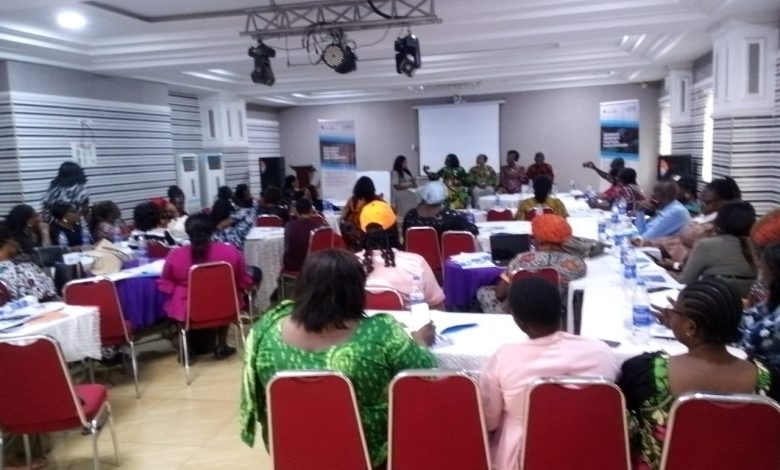
The injunction was part of outcome of a 2-day stakeholders meeting and advocacy on passage of Gender and Equal Opportunities Bill in Ebonyi State.
The meeting was jointly organised by the UN Women, Women Aid Collective (WACOL), Ebonyi State Ministry of Women Affairs, and the UN Women Political Participation Partners’ Working Group, Ebonyi State Chapter, with support from the government of Canada.
It was held September 19 and 20 in Abakaliki, Ebonyi State capital.
The gathering brought together key players in Ebonyi politics, state and non-state actors, including Civil Society Organizations, religious leaders, royal fathers, the academia and the media to also brainstorm on strategies to increase women’s active participation in Nigeria’s political governance.
Part of the strategies developed included intensive advocacy and reorientation of Ebonyi women and men against certain stereotypes and erroneous beliefs portraying political women in moral bad light.
Participants also called on women to develop leadership skills through knowledge acquisition and networking, as well as increase their visibility, value and impact in the political environment.
The UN Women representative at the meeting, Folasade Folorunso, in an address, lamented that in spite of Nigeria having ratified many regional and global instruments including the sustainable development goals, the Beijing convention which advocate 30% affirmative action and Maputo protocol which advocates for 50-50 representation, women inclusiveness in political governance is still very low in the country.
She further drew attention to the fact that Nigeria has adopted the National gender policy which recommends 35% affirmative action to advance inclusivity and representation of all gender in leadership and decision making processes, among others.
She added that the essence of the meeting was to develop strategic action plan on how to increase the participation of women in politics across the nation, and particularly in Ebonyi State
Folorunso said: “Representation of Women in Nigeria parliament where key policy decisions are made is just about 4% while there is only about 17% of women among those serving in the federal executive council.
UN Women believe that there is strength when people collaborate and coordinate their actions, particularly in advocating for things.
To beef up women’s roadmap to the 2027 elections, UN women is building strategic partnership with relevant government agencies across the country, civil society organizations and the media, to give women interested in elective posts a platform and help them build network and linkages with political parties and the electorates.”
The UN Women representative, however, applauded Ebonyi State Governor, Francis Nwifuru for increased positions and recognition so far accorded women in his administration, and urged him to sustain the tempo.
Interacting with newsmen, the WACOL’s head of programmes and administration, Nkechi Igwe, stated that her organisation has been partnering with UN Women and other partners to advance the course of women in the state and beyond.
She stressed that quick passage of the Gender and Equal Opportunities Bill is germane in the move to advance women’s interest in the nation’s politics.
She said: “In Ebonyi State, we have 24 state constituencies, and women are representing only 2.
“For us that is not enough, and that’s why we are advocating for us to have more.
“We want more women at the local government level; chairmen and Councillorship positions and also in appointive positions in the state where decisions are taken, in order to help advance issues concerning the womenfolk.
“It is only Plateau and Ekiti states that have passed the laws and we advocate that Ebonyi should follow to clinch the 3rd in the country.”
Speaking on their motivation for the meeting, Chairperson, UN Women Political participation Partners Working Group in Ebonyi State, Mrs Stella Okechukwu-Kalu, said it was as a result of their findings indicating low participation of women in both elective and appointive political positions in Ebonyi state, and the urgent need to galvanize efforts towards improving it preparatory to 2027 elections.
Kalu, also the Project Officer, Women International League for Peace and Freedom, Nigeria, said it was also to galvanize support for the Gender and Equal Opportunities Bill which has passed the 2nd reading in the. National Assembly.
In their separate good will messages, the state Commissioner for Women Affairs and Social Development, Barr. Felicia Nwamkpuma and her counterpart of the Ministry of Inter-Party Affairs, Chief Ogbonnaya Okorie, applauded the UN Women for the initiative, stressing that Ebonyi state was already taking the lead in women inclusion in governance.
Nwamkpuma, represented by the HOD, Women Affairs in the Ministry, Mrs Roseline Olughu Oji, acknowledged that though significant progress has so far been made in advancing gender equality in Ebonyi state, much was still left to be done.
Okorie enumerated key positions currently occupied by women in Ebonyi State to include Deputy Governor, Secretary to State government, Commissioners for Budget and Planning, Women Affairs, Empowerment, Aviation, Agriculture and many more, stressing that women in Ebonyi also receive preferential treatment in party politics more than men.
“Women are given fertile land to cultivate fruitfully here in Ebonyi.
“Almost all the political parties in Ebonyi state give their ticket free to the women.
“But the problem with the women here is the will; they don’t come out”, the Commissioner emphasized.
Major presentation at the meeting was delivered by Prof. Mariam Abdulraheem-Mistapha of the University of Ilorin, and consultant, National Institute for Legislative and Democratic Studies, Abuja.
The event also featured panel discussions by notable influencers across sectors.