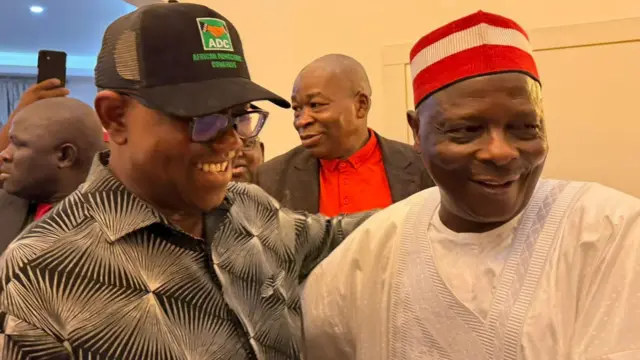

•Peter Obi and Rabiu Kwankwaso
Loyalists of former Anambra State Governor Peter Obi and ex-Kano State Governor Rabiu Musa Kwankwaso have called on the opposition to adopt a southern presidential candidate, intensifying conversations about coalition-building ahead of the 2027 general elections.
However, opposition parties, including the African Democratic Congress, the New Nigeria People’s Party, and the Social Democratic Party, differed on whether the presidential ticket should be zoned to the North or the South, reports The PUNCH.
The National Publicity Secretary of the ADC, Bolaji Abdullahi, said the party was not committed to zoning, but to the electoral viability of the contestants.
The push for a southern consensus candidate follows a high-profile political gathering in Ibadan, where opposition figures across multiple platforms reportedly explored the possibility of forming a united front to challenge the ruling All Progressives Congress in 2027.
The meeting, attended by prominent political figures, including former Vice President Atiku Abubakar, Obi, Kwankwaso and former Rivers State Governor Rotimi Amaechi, among others, resolved to work toward presenting a single presidential candidate against President Bola Tinubu.
The decision has since sparked debate within political circles, with growing calls for opposition cohesion countered by claims from the ruling party that such moves may be premature, citing internal divisions among the opposition parties.
Speaking with our correspondent on Tuesday, the National Coordinator of the Obidient Movement Worldwide, Dr Yunusa Tanko, and the National Publicity Secretary of the Obi–Kwankwaso Movement, Justin Ijeh, stressed the need to respect Nigeria’s informal zoning arrangement in the interest of fairness and national balance.
Tanko said the demand for a southern presidential ticket is rooted in equity and continuity, noting that the current presidency is already zoned to the South.
He added that Obi had aligned with this position by indicating a willingness to serve only a single four-year term.
He said, “Yes, we are concerned about the zoning. That was why we’ve been asking the ADC to zone the presidency to the southern part of this country, considering the simple fact that the Presidency has been zoned to the south.
“As you speak right now, what we have is a southern presidency. So, once you have a southern president, it simply means that even if there is going to be a replacement for the existing president, it should come from the South for them to complete their tenure.
“I think it is only fair to do that. And that was why Mr Peter Obi has also agreed that he’s going to do only four years.”
Continuing, Tanko expressed confidence that Obi would emerge as the consensus candidate if the opposition settles for a unified ticket, citing widespread public support, particularly among young Nigerians.
“That is because he’s the most popular candidate in the country at the moment. I’m being humble about it, and I thank God for it. He’s the most popular, especially among the youth. Anywhere he goes, he is adored.
“Let me give you an instance. We were on our way to Ibadan the other day, and we passed through the international and local airports. You need to see the kind of love and euphoria people showered on him. It was amazing.
“The whole hall was agog with Nigerians shouting ‘Obi, Obi, Obi.’ It was so emotional for him and for some of us who are following him. So that is to tell you the kind of love and support Nigerians are ready to give this man,” he noted.
Echoing a similar sentiment, Ijeh argued that while zoning is not constitutionally mandated, it remains a practical mechanism for ensuring inclusion in Nigeria’s diverse political landscape.
The spokesman for the Obi–Kwankwaso Movement emphasised that allowing the single presidential candidate to emerge from the South is the right thing to do.
He said, “While it is not embedded in the Nigerian constitution, and while competence and character are the gold standard for leadership ideally, zoning is a pragmatic approach to balanced representation and equity in a multipolar society like Nigeria.
“It has been practised as a convention since the return of democratic rule. Certain politicians, however, may choose to play to the gallery about it when their personal interests and ambitions are not favoured by it.
“In the current calculus for Nigeria, given our very recent political trajectory, it only makes sense for the zoning principle to be applied and for the presidency to remain in the South, in keeping with that convention.
“Anything else sets the country up for divisive complications in the near-term future, and nobody needs that.”
Speaking on the demand that the presidential ticket should be zoned to the South, the ADC spokesman, Abdullahi, said the party would rather prioritise electoral viability.
“ADC never announced a position on zoning. This is why the current alliance is workable. We will identify and support the best candidate to win the election,” he said.
Abdullahi’s position suggests that the ADC may favour an open contest in which political strength, popularity, and strategic advantage outweigh regional power-sharing considerations.
In contrast, the NNPP insisted that zoning remained an important political factor even within any consensus arrangement.
The NNPP National Publicity Secretary, Ladipo Johnson, said opposition leaders must balance national acceptability with broader political sensitivities.
“A joint candidate does not mean we cannot retain zoning. What matters is having a candidate acceptable to Nigerians across the South and North of the divide.
“If we agree to work together, it means certain things need to be taken into consideration. Getting to beat Tinubu is the task before us at this material time,” he said.
He added that discussions remain preliminary and that consultations among coalition partners are still ongoing.
“It’s just a proposal for now. Nothing is certain yet, but I am sure that consultation on this issue will continue.
“If a consensus candidate emerges, the party can still uphold zoning as long as it aligns with national unity. The consensus arrangement doesn’t necessarily override zoning principles,” he added.
Similarly, the Social Democratic Party acknowledged that zoning remained a legitimate constitutional and political consideration, though final decisions would depend on broader strategic calculations.
The National Chairman of the SDP, Shehu Gabam, noted, “Zoning is about the collective decisions of political parties and is constitutional. National political interest takes centre stage after that. It’s purely a political party’s decision to zone or not to zone.”
When asked whether the SDP would formally join the coalition backing a single opposition candidate, Gabam declined to commit. “It’s too early to tell,” he said.
The opposition’s renewed push for unity is widely seen as a response to lessons from the 2023 presidential race, where multiple opposition candidates divided anti-APC votes across regional and party lines.
Analysts say that while a consensus candidate could significantly reshape the 2027 contest, disagreements over zoning, party structure, candidate selection, and ideological differences remain major hurdles.