
Six Hundred and Four million Naira (N604,825,797.09), has been expended on the de-radicalization policy of the Federal Government.
According to a fresh spending records millions of Naira have been channelled into rehabilitation infrastructure and reintegration support for repentant insurgents under the Federal Government’s non-kinetic counterterrorism strategy, reports Daily Sun.
The figures, obtained on Monday from Govspend, a civic accountability platform, reveal a series of payments tied to dormitory construction, consultancy services, and statutory tax remittances linked to facilities used for the rehabilitation of former insurgents under the Operation Safe Corridor programme.
At the centre of the spending is a N47,436,922.88 consultancy contract awarded to ENCLEF PROJECT & CONSULTANTS LTD, paid on December 27, 2022, for supervision and production of a bill of quantities for the rehabilitation of facilities at the Kirikiri Medium Security Custodial Centre.
In the North-East, rehabilitation infrastructure expanded further with EL-HABY CONCEPT LTD receiving N41,728,606.10 on December 20, 2024, for additional construction works on a dormitory for repentant terrorists in Mallam Sidi, Gombe State, a key operational site for reintegration exercises.
The largest single beneficiary was FOSAB GLOBAL ENERGY SERVICE LTD, which handled multiple contracts and phased payments for dormitory construction under Operation Safe Corridor. The company received N151,899,923.93 on May 3, 2024, as part of approved funding for rehabilitation infrastructure.
On the same transaction cycle, statutory deductions also flowed to the Federal Inland Revenue Service. A 7.5 per cent VAT payment of N11,992,099.26 was remitted to FIRS in May 2024, alongside a 5 per cent withholding tax of N7,994,732.84, both linked to the same dormitory project.
Earlier disbursements to FOSAB show even heavier spending. On March 27, 2023, the firm received N303,799,847.88 as an additional 40 per cent payment for construction works at the Operation Safe Corridor deradicalisation and registration camp.
On the same day, government also remitted N23,984,198.52 as 7.5 per cent VAT to FIRS and a further N15,989,465.68 as 5 per cent withholding tax, all tied to the same rehabilitation infrastructure project.
The rehabilitation programme itself has grown into a major national deradicalisation framework.
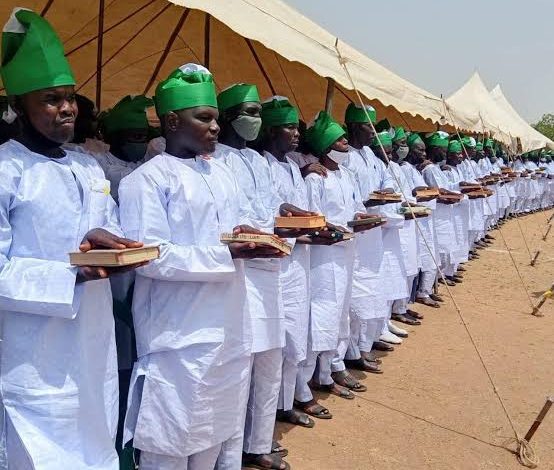
Recent figures show that the Federal Government has rehabilitated 744 former insurgents and victims of violent extremism, including eight foreign nationals—from Burkina Faso, Cameroon, Chad and Niger Republic—while 736 are Nigerians.
A breakdown shows Borno State accounting for 597 beneficiaries, followed by Yobe with 58, Kano 15, Bauchi 12 and Adamawa 10. With others spread across several states. Of the total, 733 are Muslims and 11 Christians.
At a graduation ceremony in Gombe, Chief of Defence Staff, Gen. Olufemi Oluyede, defended the initiative, describing it as part of a long-term strategy to weaken extremist ideology.
He said, “Operation Safe Corridor is a strategic intervention aimed at reducing violence and preventing the spread of extremist ideologies.”
Represented by Rear Admiral Kabiru Tanimu, the CDS stressed that rehabilitation is not an act of leniency but a security necessity.
Coordinator of the programme, Brig.-Gen. Yusuf Ali, also maintained that participants undergo structured transformation, including vocational training, psychosocial support and religious reorientation, insisting many were coerced into insurgency.
Governor Inuwa Yahaya of Gombe State, represented at the event, urged beneficiaries to embrace reintegration as a “new beginning.” He described the programme as part of Nigeria’s blended security response.
However, the financial and policy choices have continued to spark political backlash.
On Monday, spokesperson of the African Democratic Congress (ADC), Bolaji Abdullahi, criticized the reintegration policy. Just as he warned it reflects a weak grasp of the insurgency threat.
In a post on his X (formerly Twitter) handle he said, “Terrorism is not a family dispute. It is not a moral metaphor. It is a sustained and organized campaign of violence against the Nigerian state and its people.
“To respond to such a threat with language that softens its meaning, and policies that appear to prioritize rehabilitation ahead of accountability, is not compassion. It is weakness.”
“What Nigerians are witnessing is not a coherent security strategy. It is, at best, confusion dressed up as policy. At worst, a dangerous policy of political appeasement that compounds the tragedy of victims of terror,” Abdullahi added.
Speaking with Daily Trust, Chancellor of the International Society for Social Justice and Human Rights (ISSJHR), Dr. Omenazu Jackson, condemned the Federal Government’s reintegration policy. He described it as “a grave betrayal of justice” and “a dangerous precedent.”
Jackson argued that prioritizing the rehabilitation of former insurgents over victims undermines public trust and weakens the rule of law.
He said, “This policy is not only morally indefensible, it is a grave betrayal of justice, a violation of public trust, and a dangerous precedent that threatens the very fabric of Nigerian society.”
“Rehabilitation without justice is impunity,” warning that the approach could embolden violent extremism while victims remain neglected.
According to him, “a nation that fails to deliver justice for victims risks normalizing injustice.” He stressed that thousands of affected families remain without compensation or adequate support.
Jackson called on the government to halt reintegration programmes pending the establishment of clear justice mechanisms, prosecute perpetrators of terrorism, and create a comprehensive compensation framework for victims.
The controversy comes against the backdrop of earlier disclosures by the National Counter Terrorism Centre that over 5,000 repentant Boko Haram fighters have been reintegrated into society, with officials insisting that none had returned to insurgency within six months of release.
But as rehabilitation programmes expand and spending deepens, questions persist over accountability, monitoring mechanisms, and the long-term cost of Nigeria’s peace-through-reintegration model, now visibly measured not only in policy, but in hundreds of millions of naira.